for
Grid-Buffering and a Clean Fuel Supply
at the
Maine Yankee Renewable Energies Production & Research Park

|
Two needs:
Is there a single response to these two simple needs?
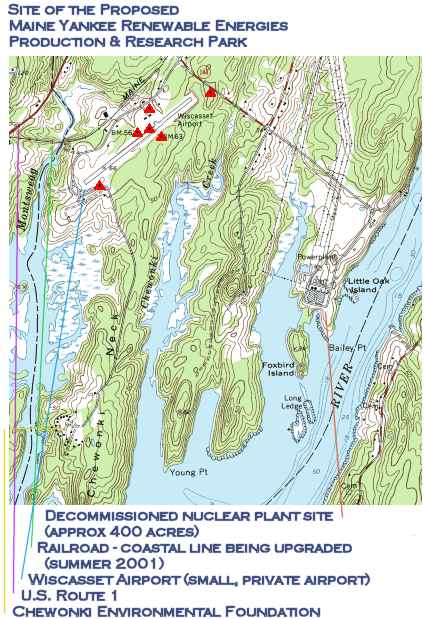 Maine Yankee is an ideal location for such a facility. The existing transmission lines allow power produced at the site, up to the level formerly produced by the nuclear plant, to be supplied to the grid. Moreover, off-peak power from every existing or planned Maine low-head hydro, solar, wind, tidal, and base-load power plant source can be wheeled to the site via the grid. 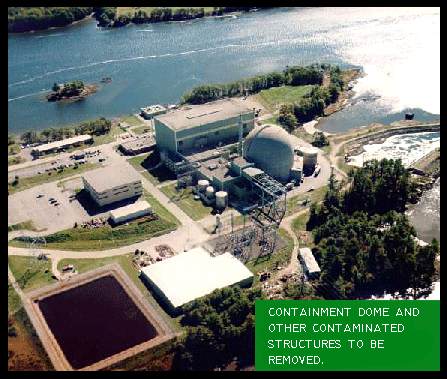 Similarly, buildings and land improvements at the site are ideally suited for electrical production, supply, and price monitoring, as well as for fuel handling and storage. The scale, spacing, building construction, and amenities were all designed with fuel and electrical safety in mind. The site’s proximity to the new major natural gas pipeline and existing rail capacity are additional benefits. How would grid-buffering work at the Maine Yankee Renewable Energies Production & Research Park? Power produced during off-peak times would be stored as hydrogen and returned to the grid as electric energy during peak demand. Despite the increase in peak demand periods, many Maine power production sources are “off-line.” The economics of the formerly-regulated utilities caused many power-production contracts to be bought out or cancelled. Biomass and many low-head hydro producers either simply stopped selling to the grid or shut down altogether. With Maine Yankee Renewable Energies Production & Research Park buying all the power these facilities produce, regardless of when it is produced, these sources will be able to come back on line. The nature of these contracts will require the Park to buy such renewable and underutilized output at all times at a reasonable (neither depressed nor inflated) price. In return, the producers will always receive the same price per kilowatt-hour, even in times of peak demand. Once this power reaches the Park, the challenge then becomes: how to store it? This is where hydrogen comes into play. Why hydrogen? Hydrogen is widely considered the most environmentally-friendly energy carrier available in today's rapidly evolving alternative energy industry. In the proposed system's energy storing mode, electrolysis would be used to make hydrogen. Electricity purchased from the renewable and off-peak suppliers would be put to work splitting water into its separate hydrogen and oxygen elements, a process that produces no pollutants. Oxygen, a by-product of making hydrogen from water, would be bottled or sold in bulk to existing industrial and medical users. The hydrogen, however, would be saved for use at times of peak electricity demand. What good does it do to have a supply of hydrogen on-site when demand for electricity is peaking? Hydrogen and electricity are two sides of the same energy coin. Hydrogen can be used to generate electricity by employing a device called fuel cell. Fuel cells convert hydrogen into electricity without combustion. One type of fuel cell simply separates the hydrogen molecule’s electron from its proton. The resulting stream of electrons creates the current needed to meet peaks on the grid. The protons pass through the cell and recombine with other electrons and oxygen to form water vapor. No pollutants are produced by this process, either. Maine Yankee's grid connection can be viewed as a two-way street. When peaking power is needed on the grid, banks of on-site fuel cells can respond by drawing on stored hydrogen to generate power. When grid demand is low, power could be pulled from the grid to create hydrogen. In addition to the renewable and co-generation plant power added to the grid as a result of the activities of the Park, there is also existing grid power. This existing grid power, available at low cost during times of low demand, can be considered relatively clean, since the plants that generate it must run steadily and are either fired with natural gas or have clean-burning technologies associated with them. Plants that are fired up to meet peak demand that are the dirtiest, however. The proposed hydrogen-based Maine Yankee Renewable Energies Production & Research Park would reduce the need to fire these plants. No system is 100% efficient. In this grid-buffering method too, there are significant efficiency losses in both the electrolyser and the fuel cell. An electrolyser’s inefficiency may be offset by income from oxygen sales. Fuel cell inefficiencies are offset to the extent that their considerable waste heat can be used in other on-site applications, like heating buildings through a combined heat and power (CHP) arrangement. Even with oxygen sales and CHP production, efficiency losses are a factor. However, since this power will be sold to the grid at premium peak prices, the amount received for that power should be enough to offset these inefficiencies and allow a reasonable profit. When should we use hydrogen for hydrogen itself, instead of using it to make electricity for the grid? Today hydrogen has substantial value in many applications -- as a simple industrial gas, a food additive (for hydrogenation), and as a cleaner gasoline-refining tool. Tomorrow it will have even more value as a pollution-free fuel for cars, as a battery replacement in consumer electronics, and as the fuel for off-the-grid home electrification and heating units. Its value for these uses is higher than any reasonable price for electricity. Consequently, the Park should be set up not just to store hydrogen to produce peak-priced electricity, but also to produce and distribute consumer hydrogen. Most major car manufacturers have hydrogen cars projected to be on the road between 2003-6. There are also dishwasher-sized fuel cells that generate home electricity (see www.plugpower.com) that run on hydrogen. Lawn mowers and snowmobiles are not far behind. Currently, the fuel cells in most of these vehicles and devices derive their hydrogen from a process called "on-board reforming" of fossil fuels and accept fuels like methanol, gasoline, natural gas, or propane. In their ultimate, optimal configurations, however, their hydrogen fuel will be in pure form, provided to consumers in pre-filled tanks and canisters, eliminating the bulky on-board reformers that add weight, take up space, and still release carbon dioxide as they reform a fossil fuel or other hydrocarbon into hydrogen. Before leaving the subject of reformation, though, please note that the Maine Yankee site is a mere seven miles from the new Sable Island-to-Westbrook, Massachusetts natural gas pipeline. This suggests some highly complementary uses to add to the proposed Maine Yankee Renewable Energies Production & Research Park. Whether a spur pipeline is built to the site, or existing rail lines are used to bring natural gas to the site from the pipeline by train, that natural gas could be of great value in two ways. First, a clean, efficient combined-cycle natural gas turbine generation plant could be built, similar to many other new Maine plants. The difference would be that not one kilowatt of this capacity would go unused. If low demand required the plant to "spill" power, it could send that power directly to the nearby electrolyzer instead, with no wheeling charges or transmission losses. Second, natural gas could be reformed into hydrogen to supplement any shortfall in the planned hydrogen output from the on-site electrolyzers and renewable resources "wheeled" in via the grid. In short, the site could start operations using two established technologies: electricity production from natural gas turbines and hydrogen production from natural gas reformation. These technologies serve today's existing markets at a profit. The proposed Park would move these technologies into two pollution-free, renewable resource technologies: electrolyzers and fuel cells. These newer technologies will serve tomorrow’s markets at a profit as well. As the Park forms a bridge from one era to another, these two sets of technologies will be able to operate in a symbiotic relationship that will ensure optimal use of the Maine Yankee site. This environmentally progressive use for the Maine Yankee site takes advantage of the existing infrastructure (an interface to the New England electric power grid and considerable switching equipment), offers the prospect of appropriate commercial development, and opens Maine's doors to the future of energy technology - "hydrogen-as-fuel." The Park would attract academic, research, and commercial activity in the field of renewable power generation and focus on the use of hydrogen as the main carrier of this renewable energy. Research is an on-going effort within every sector of our economy, especially so in one as young as the "hydrogen-as-fuel" industry. Including research facilities and attracting active, cutting-edge companies to the Park would be an important aspect of its development. If a critical mass of production, research, and manufacturing interests could be brought together at the proposed Park, the area would have a new, clean industry supporting its growth and prosperity.  The processes and equipment involved in the proposed installation are by no means insignificant, but once the investment has been made, a local source of hydrogen would be available and local seeds would be sown for this promising technology. Maine could join California and other states that are already looking to hydrogen as an environmentally friendly way to store and (re)produce electric energy, leading the way out of the woods on both the long-term global warming front and the short-term power shortage front. Since hydrogen is an energy carrier that does not involve carbon dioxide (a major greenhouse gas released whenever a fossil fuel is burned), it is an excellent alternative fuel. Safety concerns are paramount when generating and storing significant quantities of hydrogen and oxygen. The danger from a stored quantity of hydrogen is similar to that of natural gas, although most people would agree it is far safer than a nuclear power plant. Safety is a concern that has been addressed by many groups, including the companies that make storage systems for hydrogen and oxygen. More about hydrogen safety can be found at the National Hydrogen Association's site: http://www.hydrogenus.com/hhs_1.htm Any competent engineering firm would able to handle all the design, installation, and setup work for this hydrogen-based grid-buffering and hydrogen supply system. The links page of the Hydrogen Energy Center's site can help to shed some more light on hydrogen and how it works as an electrical energy storage medium. That page also has links to the companies that will make the equipment that will be needed (large scale electrolysers, fuel cells, and storage systems). For the links page: www.h2eco.org/links.htm Rick Smith, President Please send comments to: [email protected] Updated 5-24-01 tpc |